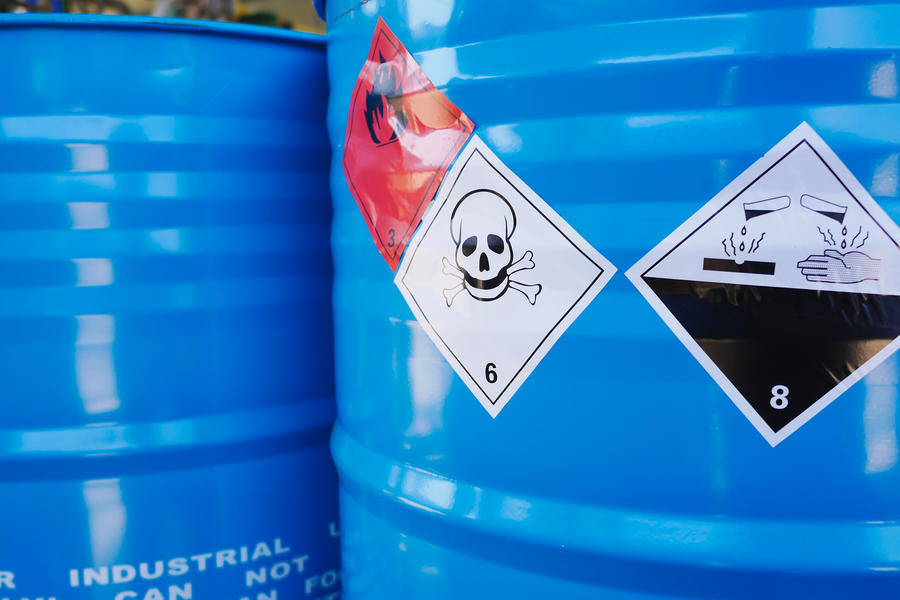
Assessment legal requirements ARIE and/or Seveso III Directive
Compliance with legal requirements related to (large quantities) of hazardous substances
- Compliance with the legal requirements regarding the use or storage of (large quantities) of hazardous substances requires specific knowledge and expertise
- Compliance is closely monitored by the NLA (Labour Authority)
- Depending on the nature, impact and circumstances detected violations the Labour Authority can impose fines and penalty payments or proceed with close down of business activities or criminal prosecution
- Bureau Veritas offers expert consultancy, coaching and support to help companies to comply with applicable legislation through targeted and scalable customization
Legal context: Major Accidents (Risks) Decree and Seveso III Directive
Both on national and European level strict safety requirements have been put in place for companies dealing with large quantities of hazardous substances (previously specified under the Major Accidents (Risks) Decree).
These requirements are included in the European Seveso III Directive and the Dutch Environmental and Planning Act. Since 2024 this act includes – next to various legal regulations – also the Major Accidents (Risks) Decree (previously known through the abbreviation BRZO) which came into force in 2015. Within this law the companies which have to comply are referred to as ‘Seveso institutions’ in alignment with the Seveso III Directive.
This legal framework aims at avoiding major accidents which may result from storage and application of hazardous substances and mitigating health and environmental consequences.
Companies which are subject to these requirements have to put in place a safety policy and subsequent report and need to apply for one or several permits.
Additional Risk Inventory & Evaluation (ARIE) Regulation
To companies dealing with smaller quantities of hazardous substances compared to the Seveso III Directive the legal requirement of an Additional Risk Inventory & Evaluation (ARIE) applies. This regulation has been specified within the Working Conditions Decree and puts a focus on health and safety risks in connection with hazardous substances.
In 2023 the decree has been revised and updated and currently also applies to a large part of the so called ‘Seveso Institutions’. This revision has had consequences for companies which previously had to comply with the ARIE requirements, but also for companies which have to comply since the revision became into effect.
The ARIE Regulation applies to companies dealing with substances similar to those which are subject to the Seveso III Directive (with the exception of corrosive substances), however the threshold for the ARIE Regulation has been set at a lower level and equals approximately 30% of the Seveso quantities.
Do you want to find out if your organization has to comply with the ARIE requirements? Consult the ARIE decision tree.
Is your organization required to comply with the ARIE requirements?
Consult the ARIE decision tree

Seveso III institutions or companies
Seveso III institutions or companies
The Seveso III Directive specifies 2 types of companies to which this framework applies:
- Low threshold Seveso III institutions – for this type of companies the requirements are less strict (these companies do not require a safety report for instance); however, these companies need to put in place a safety policy, operate a safety management system and are required to report incidents.
- High threshold Seveso III institutions – these companies face extra requirements such as a detailed safety report or contingency plans.
Contrary to Seveso III institutions the ARIE Regulation does not apply to environmentally hazardous substances and only for substances which might be a risk for employees inside or outside the facility.
There is also a difference between the scope of the ARIE Regulation and a risk inventory and analysis for hazardous substances. Both the ARIE Regulation and the Seveso III Directive focus on acute dangers and risks when large quantities of hazardous substances are released through fire, explosion or toxic cloud. A risk inventory and evaluation for hazardous substances relates to frequent exposure to small quantities of hazardous substances and to the effects which may occur over a longer period of time.
Scope of application
The Environmental and Planning Act is applicable to companies which use and/or store large quantities of hazardous substances as part of their business operations. This legal framework applies to companies in various business sectors, including the (petro)chemical industry, general industry, food production and processing, pharmaceutical industry and logistics.
Compliance support ARIE Regulation and/or Seveso III Directive
Companies which are subject to compliance with the ARIE Regulation and/or the Seveso III Directive have to evaluate the effectiveness of the practical implementation of the relevant measures at least once every 5 years or more frequently if necessary, for example in case of changes which might occur meanwhile.
This recurrent evaluation ensures that measures and initiatives taken in view of compliance remain up-to-date and will be in alignment with potential changes in business activities or the relevant legislation. Additionally periodic reviews will contribute to continuous improvement of safety in the workplace.
Our ARIE / Seveso III experts have both the relevant knowledge and the experience to provide you with practical support regarding compliance with your legal requirements. Bureau Veritas Solutions offers a broad scope of consultancy, coaching and support services, including:
prevention policy major accidents; safety management system; actual substance inventory; safety measures for installation scenarios; safety reports (QRA and MRA); action plan; internal emergency plan; safety culture; hazard studies (including HAZID, HAZOP, LOPA); explosion safety (ATEX); risk inventory and evaluation; fire safety scan; process safety.
Deliverables and benefits of our services
The major goal of our services is to aim for full compliance and to avoid potential sanctions (such as fines, penalty payments, (temporary) shut down of business operations, criminal prosecution) and additional costs.
Our approach is based upon scalable customization which takes your needs and wishes into consideration besides taking your specific business environment into account. After completion of our support activities our customers will be well prepared for the (periodical) inspections which are performed by the Labour Authority.
Download our ARIE REGULATION & SEVESO III DIRECTIVE brochure here
Download